

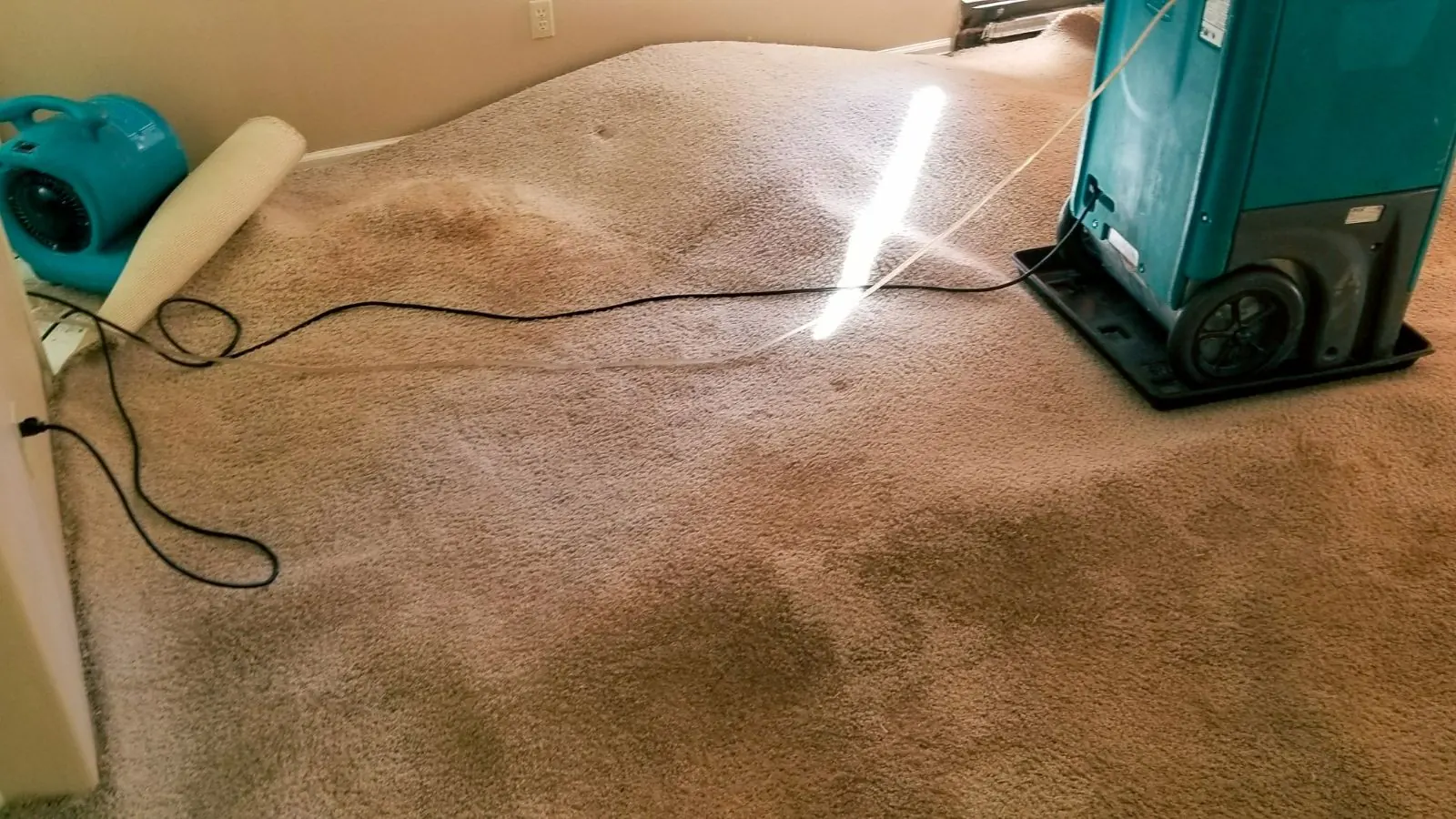
Carpet has two layers that matter, the carpet itself and the pad under it. The carpet is usually synthetic and dries well. The pad is a foam or fiber layer that holds water and is hard to dry in place. That is why the question after a leak is often about the pad, not the carpet.
This page covers wet carpet after clean water leaks, and how the decision to dry or discard is made. If the water was sewage or flood water, see sewage cleanup or flood damage cleanup, since contaminated carpet is generally discarded.
Dry or discard: how the choice is made
| Situation | Usual outcome | Why |
|---|---|---|
| Clean water, caught quickly | Carpet and pad often dried | Little contamination and short contact |
| Clean water, sat for days | Pad often removed | Pad holds water and grows odors |
| Gray water from an appliance | Case by case | Depends on the source and the time |
| Sewage or flood water | Discard | Contaminated and porous |
| Visible mold or strong odor | Remove affected area | See mold remediation |
How wet carpet is dried
Standing water is extracted with a weighted wand that pulls water from the carpet and the pad. Air movers blow across the surface, and a dehumidifier removes the moisture. In some cases, the carpet is lifted at an edge and floated so air can reach the pad and the subfloor.
If the pad is removed, the carpet can often be put back on new pad after the subfloor dries. The crew checks the tack strip, the baseboard and the lower wall, since water wicks upward from the floor.
Wet carpet in a room?
Call and say whether the water was clean and how long it sat.
Carpet cleanup steps
- Stop the leak and remove standing water.
- Lift furniture or put blocks under legs to keep stains from spreading.
- Extract water from the carpet and the pad.
- Lift the carpet edge to check the pad and the subfloor.
- Dry with air movers and a dehumidifier, using readings.
- Replace the pad if needed, and reinstall or replace the carpet.
Odors and stains after a leak
A musty smell often means the pad or subfloor stayed wet. Cleaning the surface does not fix that, because the source is under the carpet. Treating odor means finding the wet layer and drying or removing it.
Stains from rust or dirt may remain after drying and may be treatable by a carpet cleaner. If you see growth on the back of the carpet or on the subfloor, see remediation for mold after leaks.
What happens to the tack strip, baseboards and subfloor
Carpet is held at the walls by a tack strip, and the strip sits on the subfloor. When carpet is lifted for drying, the strip can stay in place if it is dry, though wet wood strip is often replaced because it will not hold well after it swells. Baseboards are checked for moisture behind them, since water wicks into the wall base.
The subfloor is the layer that decides how long the job takes. Plywood and oriented strand board dry in days when air reaches them, while concrete takes longer. A reading on the subfloor before new pad goes down prevents the common mistake of sealing moisture under fresh carpet. That mistake is why some rooms smell musty again a month after a repair.
Carpet water damage cost factors
Water category
Clean water allows more salvage than contaminated water.
Time wet
The longer the pad stays wet, the more likely it is removed.
Area
Large rooms need more equipment.
Pad and tack strip
New pad and strip add to the cost of a re-lay.
Cleaning
Cleaning after drying is separate from mitigation.
Carpet and pad lost to a sudden leak may be covered, whereas a long-running seep may not be. Keep a sample of the pad if it is removed, and confirm the cause with your insurer. Call (833) 521-1033 for an actual number.
Whether wet carpet and pad can be saved follows the water category described in the ANSI/IICRC S500 standard, which is why the source of the water matters.
Carpet Water Damage Questions
Can wet carpet be saved?
Often yes if the water was clean and it was dried quickly. The pad is usually the bigger concern.
Do I have to replace the pad?
Not always, but pad that stays wet or smells is commonly replaced. A moisture reading and a look under the edge help decide.
Why does the room smell musty a few days later?
That often means the pad or the subfloor is still holding moisture. Drying that layer is the fix, not more surface cleaning.
Can I rent a wet vac and handle it myself?
For a small spill, yes. For a soaked room, professional extraction and drying reach the pad and subfloor in a way a household wet vac cannot.