

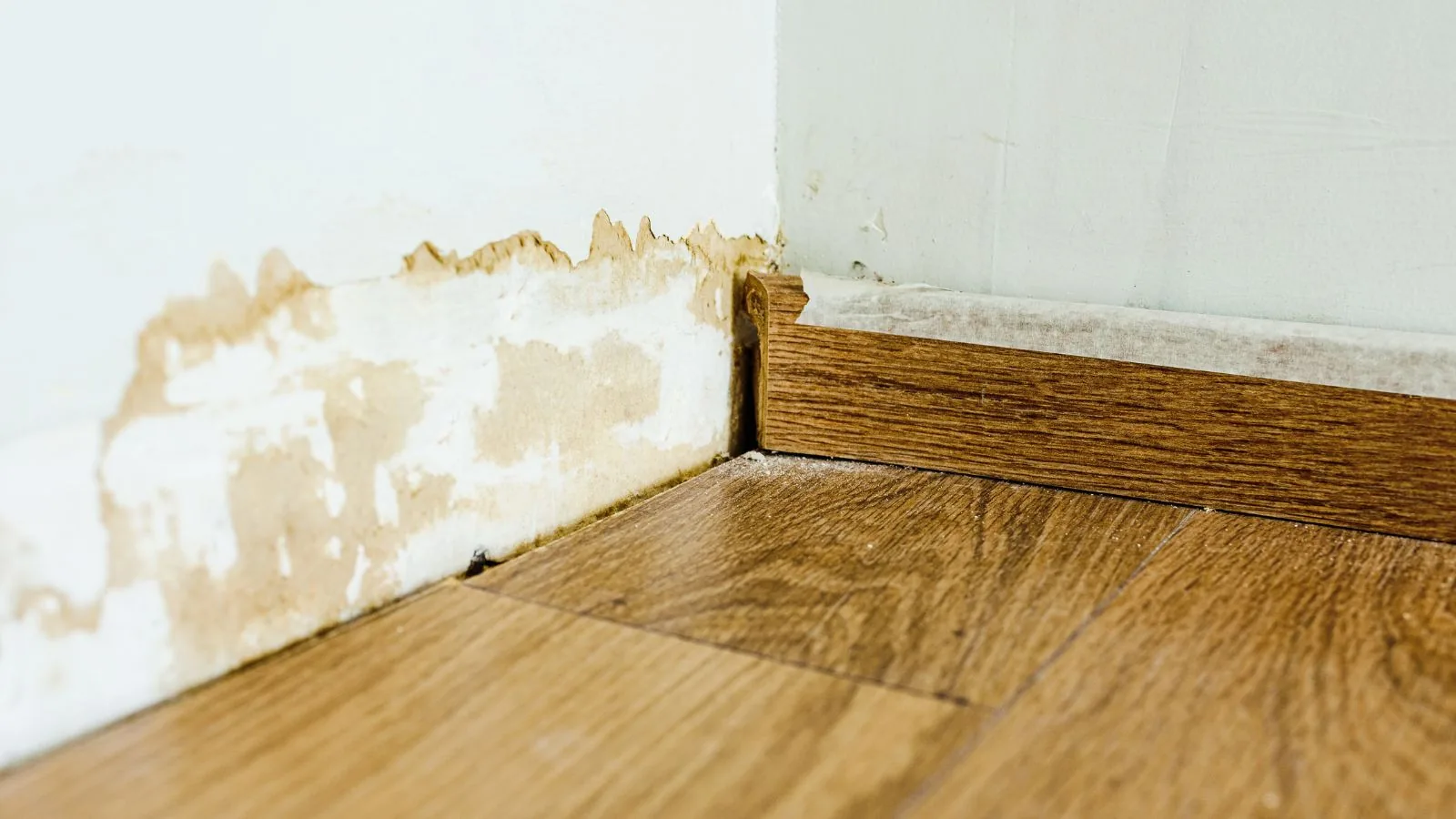
Drywall is gypsum between paper, and it soaks up water like a sponge. A leak at the floor level can wick up a wall for a foot or more, and a leak in a wall can run down inside the cavity. The surface can look normal while the inside is wet.
Signs include a stain, bubbling paint, a soft spot, a bulge near the baseboard and a musty smell. This page covers what to do about wet walls. For ceilings, see ceiling water damage repair.
Signs the wall is wet
Stains and bubbling paint
Water travels through the paper face and lifts the paint.
Soft or crumbly drywall
Gypsum loses strength when wet and crumbles when pressed.
Cool, damp feeling
A wall that stays cool and damp is holding moisture inside.
Baseboard gaps and swelling
Wood trim swells when water wicks up from the floor.
Dry in place or cut it out
Drywall that got wet quickly with clean water and has not lost its strength can often be dried in place. A small hole drilled near the baseboard can let air move behind the wall, and air movers and a dehumidifier do the rest. Readings confirm progress.
Drywall is removed when it is saturated, when it is crumbling, when it was in contact with sewage or flood water, or when mold has started. A flood cut, which is a straight cut about a foot or two above the water line, lets the cavity dry. Wet insulation is removed, since it holds water against the framing.
Wall damp or bubbling?
Call and say where the stain is and how long it has been there.
Wall repair steps
- Find and stop the water source.
- Remove baseboards and check readings in the wall.
- Cut out drywall that cannot dry, and remove wet insulation.
- Dry the studs and cavity with air movers and a dehumidifier.
- Confirm the framing is dry with readings.
- Replace insulation and drywall, then tape, mud, prime and paint.
Dry in place versus cut out
| Condition | Likely path | Reason |
|---|---|---|
| Slightly damp, firm, clean water | Dry in place | Paper and gypsum are intact |
| Saturated or soft | Cut out | Gypsum loses strength |
| Sewage or flood contact | Cut out | Contaminated and porous |
| Visible growth | Cut out and clean | See mold remediation |
| Wet insulation in the cavity | Remove insulation | It holds water against studs |
Paint, texture and matching the finish
Once the framing is dry and the new drywall is hung, the seams are taped and covered with joint compound. The compound is sanded smooth after it dries, and several coats are normal. Skipping the drying time between coats leads to cracks and ridges.
Texture is a separate step. Walls may be smooth, orange peel or knockdown, and the patch must match the surrounding finish. Paint is then primed and applied, and painting the whole wall to the corner hides the repair better than painting a patch.
Stain-blocking primer is used on any area that was stained by water. Without it, the stain can bleed through the new paint. If the patch will be near a kitchen or bath, a moisture-resistant board may be an option, and a contractor can say what fits.
Ask for the finish work to wait until moisture readings are logged as dry. A good repair is one nobody can find a year later.
Questions to ask before drywall is cut
Ask where the cut will go and what reading justified it. A flood cut a foot or two above the water line is common, and a taller cut should have a reason. Ask whether the insulation behind it is wet, and whether the baseboard and trim will be saved and reused.
Ask how the dust will be contained, since drywall cutting makes a lot of it. Plastic sheeting and a taped doorway keep it in one room. Finally, ask when the new drywall goes up, which should be after the studs read dry.
Wall water damage cost factors
Height of wicking
Water that climbed higher means more drywall.
Insulation
Wet insulation is removed and replaced.
Finish work
Taping, texture and paint matching are repair costs.
Water category
Contaminated water leads to removal.
Hidden source
Finding a leak inside a wall can add investigation time.
Wall damage from a sudden pipe failure is often covered, and from a slow hidden leak often is not. Photograph the stain, the cut and the readings, then ask your agent where your policy draws the line. Call (833) 521-1033 for a figure.
Whether wet drywall can be dried in place or must be cut out is guided by ANSI/IICRC S500.
Wall and Drywall Water Damage Questions
Can I just paint over the stain?
Paint does not dry the wall. If the wall is still wet, the stain returns and mold can start behind the paint.
How high does water climb in drywall?
It can wick a foot or more above the water line. Moisture readings find the edge.
Do I have to remove all the drywall?
No. Only the part that cannot dry is removed, and readings decide where the cut goes.
Who patches and paints afterward?
The repair stage covers drywall, taping and paint once the framing is dry.